
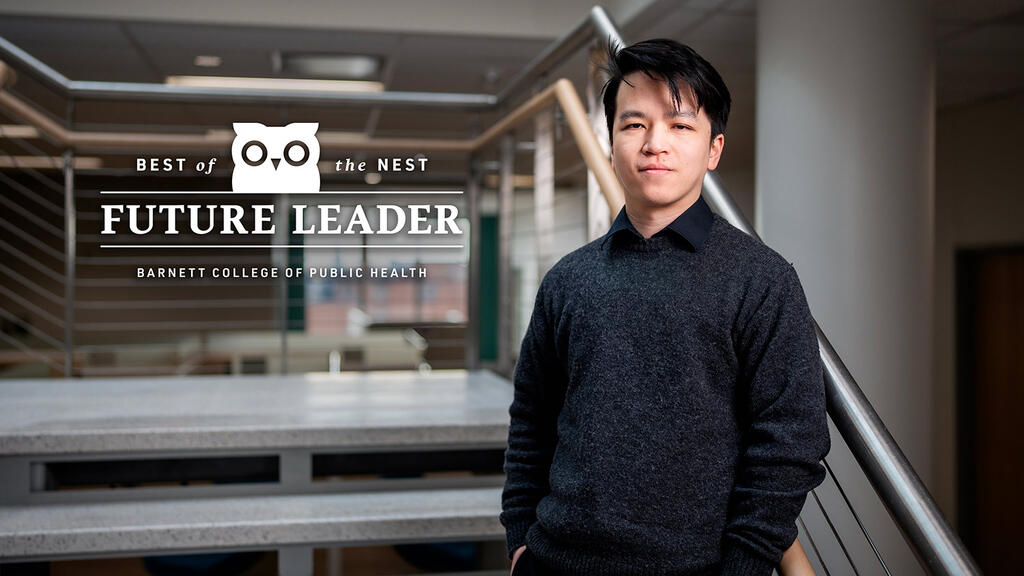
When Haoyu Zhou was accepted into the Duke & Chen Institute Joint Boot Camp for AI & AI-Accelerated Medical Research, he spent five days immersed in new tools and ideas that reshaped his perspective. “It really updated my understanding of AI tools—what they can do, and what those researchers are trying to achieve,” he says.
As a PhD student in epidemiology with a strong research focus in biostatistics in Temple University’s Barnett College of Public Health (CPH), Zhou works at the intersection of statistics, AI, and real-world health data. Before coming to Temple, he earned his MS in biostatistics from NYU, where he built machine-learning models to predict abdominal aortic aneurysms. “That was the first time I knew these methods could contribute significantly to the underlying research matter,” he says.
At CPH, his dissertation focuses on post-COVID conditions using electronic health record data that are rich but often incomplete. “The complete cases might only make up a very small proportion of the whole sample,” he explains. “That complicates the goal of objective analysis.”
His work uses a method that fills in missing information by creating several complete versions of the dataset and then combining the results to get a more reliable answer. “The basic idea of multiple imputation is that one imputation might not reflect the uncertainty due to missing data," he says. “But when we impute many times, we are able to capture that uncertainty in the analysis.”
Zhou also collaborates on twangMediation, a software tool that helps researchers study how and why one factor leads to another in health outcomes. He joined the project even before officially beginning the PhD program. “People can just enter simple things about their data, and it will automatically output a whole set of analysis results,” he explains.
He embraces AI in his own workflow, too. Through industry internships, Zhou explored custom GPT tools that automate documentation. In his research, he uses AI to help draft R functions, the code behind his statistical work. “After a few revisions, the code usually runs with no problem,” he says. “It’s a very efficient tool that might still be underestimated in research.”
Zhou chose Temple because of the mentorship and flexibility he found here. He has taken advanced courses in both epidemiology and statistics, including doctoral-level statistics classes in the Fox School of Business. “I really appreciate that flexibility,” he says.
The dissertation is his primary focus: “I wake up thinking about it,” he admits—but he’s motivated by the impact he hopes to make. After graduation, Zhou is open to pursuing a postdoc or moving directly into industry, especially in clinical trials and drug development. “If I can do work that is directly part of clinical trials,” he says, “then I feel that’s a very solid contribution to people’s health.”